A proposal for student affairs & residence management
Your students already run an economy. Give it a campus where everyone is verified.
Tutoring, braids, design work, textbook sales, laptop repairs — it all happens today, through WhatsApp groups and notice boards where nothing is verified and the university has no visibility. Nearra gives your campus a private board where every member has proved they're a student with their university email address: students trading with students, each one verified.
For the committee, in one minute
- What it is
- Verified students, trading locally. A campus-only board inside the Nearra app where every member has proved a university email address, and students find, hire, buy from and sell to each other. Skills, a marketplace, requests and messaging all sit behind that one idea. Each residence can have a board of its own.
- What students pay
- Nothing. The institution sponsors it as a student-life benefit.
- What the university pays
- One subscription sized to enrolment — from R2,490 a month per campus. The subscription activates the board.
- What verified means
- A member proved a university email address. It says who they are, not how good they are — reviews, block and report do that part. What it rules out is the stranger from a public classifieds site at the res gate.
- What the university controls
- Which email domains verify, which residences are listed, and the right to stop at any time. Nothing installed, nothing integrated with student systems.
- Who's behind it
- Nearra (Pty) Ltd, a registered South African company based in Cape Town. Campus verification is live in the product today.
What students see
Verification is not a plan — it runs in the product today.
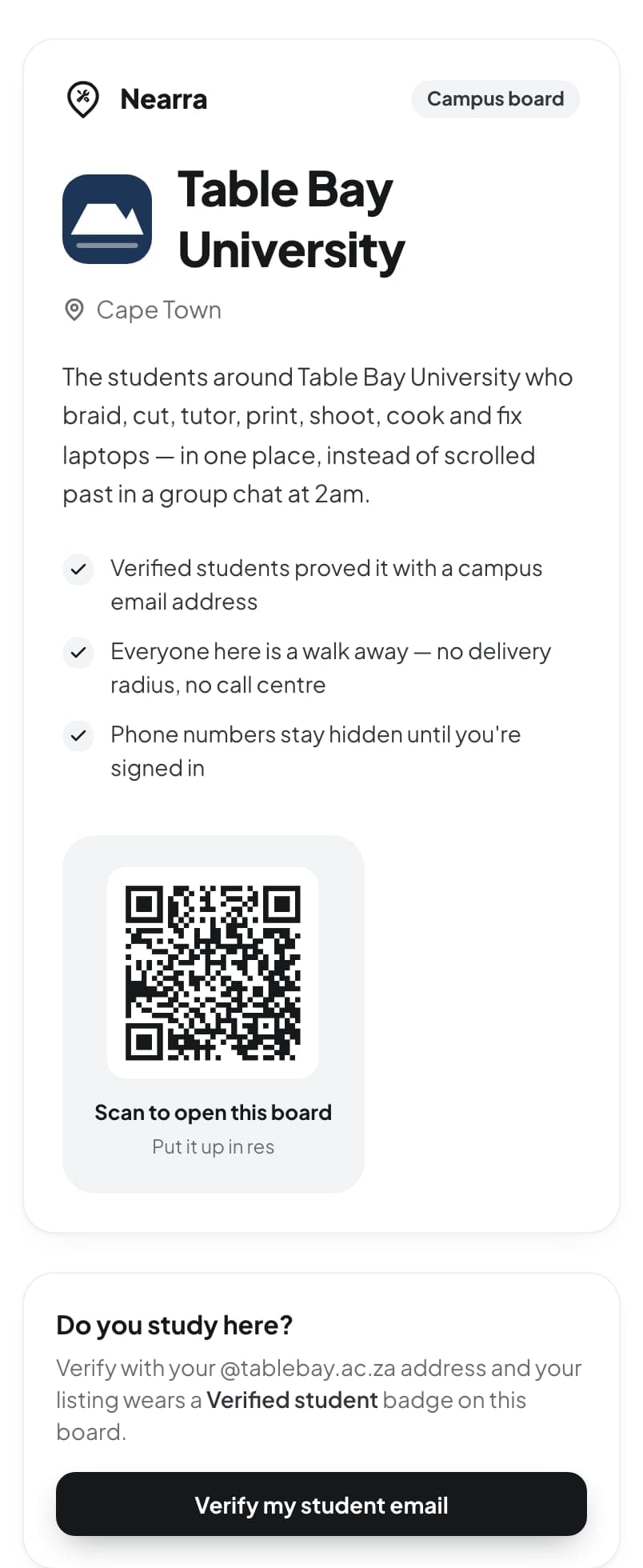
The campus board. A QR for res, and verification with the student's own university address.
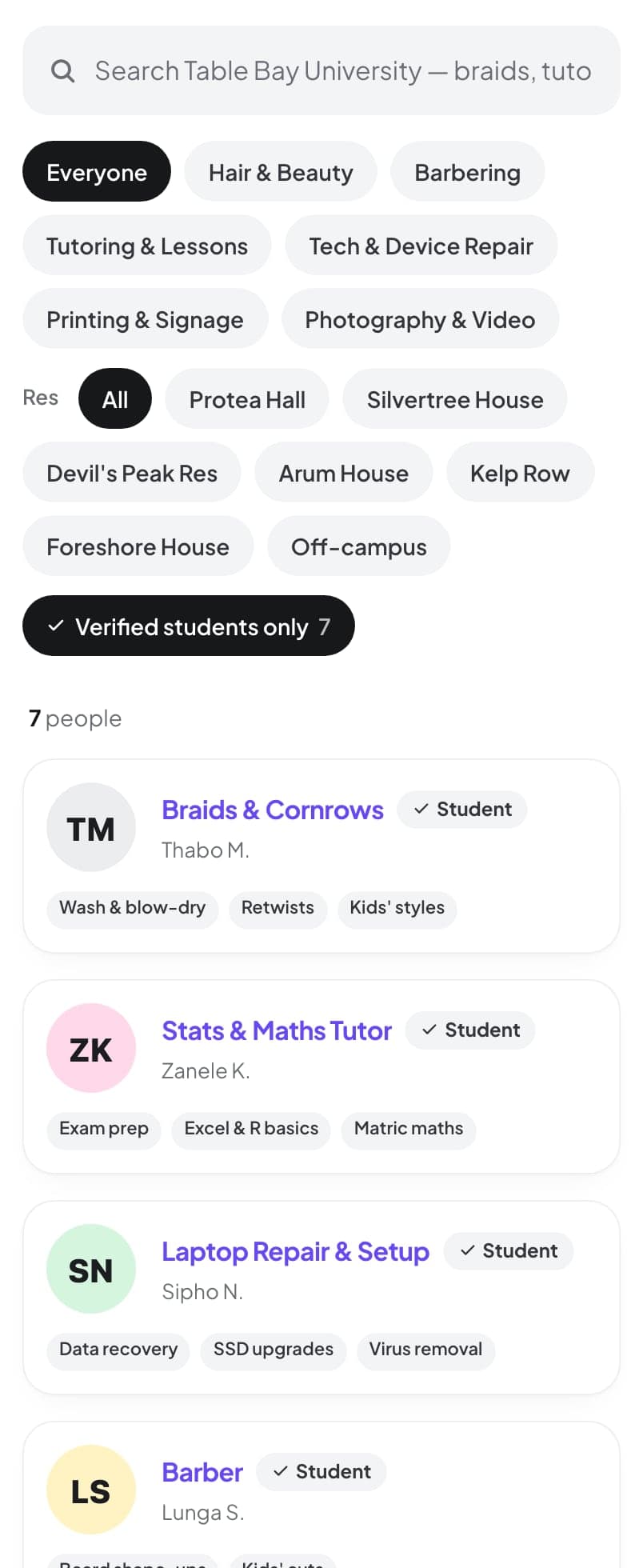
Filter by residence, or verified students only. Every verified listing wears the Student badge.
Screens from the demo campus with sample students. Your campus carries your name, your residences and your email domain.
What students get
Earning between lectures — the tutor, the braider, the designer in the next res: listed, searchable, and verifiably students of your university.
A campus marketplace — textbooks, mini-fridges, bikes. Collection is a walk across campus, between verified students.
Requests — “anyone tutor STATS 101 before Friday?” reaches the students who can, not a group of six hundred who can't.
Messaging and reviews built in — students contact each other in-app and rate the work, so reputation builds inside the campus community.
The wider neighbourhood too — the campus board sits on top of Nearra's public map. Students choose which side they're browsing.
What the university gains
Verified identity before anything else — a student can check that the person they're about to meet is a student too — before the meeting, not after. The manager dashboard shows whether the campus board is actually being used.
A student-life benefit with substance — visible support for student entrepreneurship, at a cost that disappears inside a student-affairs budget.
A notice, in the same place — res announcements and campus notices as one card at the top of the board, from the office. Not a chat, not a replacement for anything — a noticeboard on the way to the directory.
Money staying on campus — students earning from students, and a campus economy the institution can finally see in a monthly one-page report.
Nothing to integrate — nothing to host, no student-system access. Verification runs on the email addresses you already issue — procurement still gets its questions answered, but IT doesn't get a project.
What it costs
Sponsored by the institution. Free for every member.
| Up to 5,000 students | R2,490 / month |
| 5,000 – 15,000 students | R4,990 / month |
| Larger, or multi-campus | Custom |
Annual billing is 12 months at the same monthly list rate. Free for every student, always. No setup fee.
How activation works
Create the institution account, choose the subscription, then invite students.
Step 1
Create the institution account
Add the campus, enrolment and student email domain. No document upload or pre-approval queue.
Step 2
Choose a subscription
Pay monthly or annually at the published list rate. The annual option has no discount.
Step 3
The campus activates
Paystack confirms payment, then the student board and email verification become available.
Ongoing
Manage branches and access
The owner account can add campuses and assign scoped administrators as the institution grows.
What the dashboard measures
For a 400-bed residence, these are useful adoption targets after launch:
- 100 students verified — one in four
- 40 students listed a skill or an item
- 30 student-to-student connections made
- Half of active members back in month three
These are management targets, not conditions for a discount. The published subscription price remains the price.
More than one campus?
Each campus gets its own board — and each residence can have one inside it. Local stays local. For multi-campus institutions: one account, one payment at the sum of each campus's list price, rolled out at your pace.
What it replaces — and what it doesn't
Nearra isn't competing with software the university might build. It replaces the way this already happens: the WhatsApp group, the Facebook group, the res noticeboard, word of mouth — and often nothing at all.
- What stays: the groups, for conversation. Nobody is asked to leave them.
- What moves: finding people. A persistent, structured directory of what students offer, with membership verified by university email and reviews that accumulate — instead of a tutor recommended in a group of six hundred, by someone who could be anyone.
- What never changes: students still arrange and pay each other directly, off Nearra, exactly as they do today.
The questions the committee asks
“Why not just a WhatsApp group?”
“Students already have Facebook and WhatsApp groups for this.”
They do, and nothing in them is verified. A “tutor” in a group of six hundred could be anyone. On the campus board every listing belongs to someone who proved a university email address — and the groups stay as they are.
“How is a student verified?”
With their own university email. They enter it, receive a code, and their listing wears the Student badge for twelve months. The university hands over no data; verification runs on the addresses you already issue.
“Who moderates it?”
Students can block and report in two taps, and every report reaches a human at Nearra. No money passes through the app, so there is nothing for a scammer to collect.
“What about students' personal information?”
Nearra is a South African company operating under POPIA. Students decide what appears on their own profile; phone numbers are hidden from strangers, and nobody's exact location is ever shown.
“Can we stop?”
Yes. The board stays active for the period already paid for, then the institution can choose whether to pay for another period. Students keep their free public Nearra profiles either way.
“We could build this ourselves.”
You could, and the instinct is right. Building it means a software project inside the institution — hosting, security, support, app-store accounts — and a team to keep it alive after the students who started it graduate. Adopting Nearra means live in a week, maintained by the people who built it, and reversible — no lock-in, no data held hostage.
“Which office would own this?”
Typically student affairs or residence management. The owner account can be created first, but payment is required before the campus goes live.
The question students (and parents) ask first
“Is it safe?”
Nobody's exact location is ever shown.
A profile shows a residence or an area name — never a room, never a pin on a building.
Contact details are not public.
Phone numbers and WhatsApp are hidden from strangers — only signed-in people can see them, and every reveal is recorded.
Each student chooses what they share.
They pick which contact channels appear — or none, using only in-app messages.
Block and report are built in.
Anyone can be blocked or reported in two taps, and reports come to a human.
No money passes through Nearra.
Students deal with each other directly, exactly as they already do — Nearra just makes finding each other easy.
Verified means a student, not a guarantee of the tutoring.
The Student badge says this person proved a university email address. How good they are is what reviews say — built up honestly, one job at a time.
See it before we meet
Open it on your phone. Nothing to install, no account needed to look.
The product is live today, campus verification included. Open the sample board, then create the institution account and activate it with a subscription when the committee is ready.
Nearra — your neighbourhood, mapped
Nearra (Pty) Ltd · Reg. 2026/669169/07 · Cape Town · www.nearra.app · hello@nearra.app